Rider-Waite-Smith
The Story
The Rider-Waite-Smith was first published in London in 1909 by Rider & Company. It was created under the direction of Arthur Edward Waite, who wanted a deck whose pictures carried genuine symbolic weight.
The artwork is by Pamela Colman Smith, the artist who painted all 78 cards. Her great contribution was this: the Rider-Waite-Smith was the first tarot deck to carry a full pictorial scene on every card, including the numbered suit cards, which earlier decks had shown as plain arrangements of their suit symbols. That is why nearly every modern deck descends from it. Her artwork is now in the public domain, and she deserves to be named — so on this page, she is.
Why I Read With It
The pictures speak plainly. Hold one of these cards up to someone who has never seen tarot before and they can tell you what it shows — a traveler at the edge of a cliff, a figure pouring water between two cups, a moon rising over two towers. A reading here starts from a picture you can see for yourself, not from a symbol you have to take my word for.
Its symbolism is also the traditional language this shop teaches in. The Card of the Day teachings in Ava's Study and the reversed meanings in the cheat sheet are written from these cards, picture by picture, so what you learn there is the same language your reading is spoken in.
And it is the deck you will actually see. In most readings, the spread photo that arrives with your reading shows these same cards, in this same artwork — the deck on this page is the deck on my table.
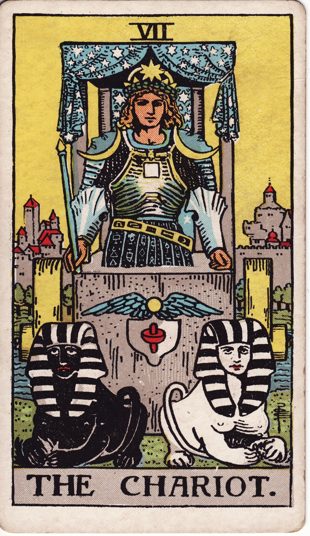
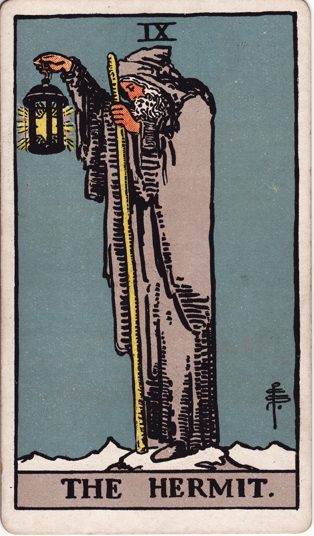
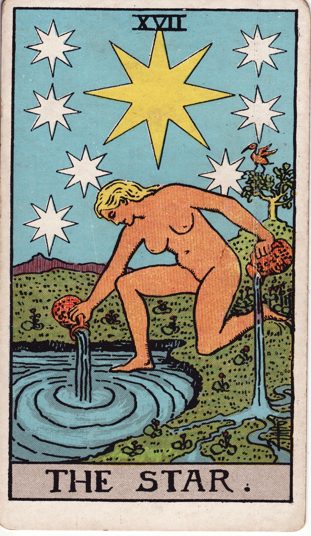
Six Cards From the Deck
Six of its best-known cards, and what each one tends to speak to when it turns up in a reading.
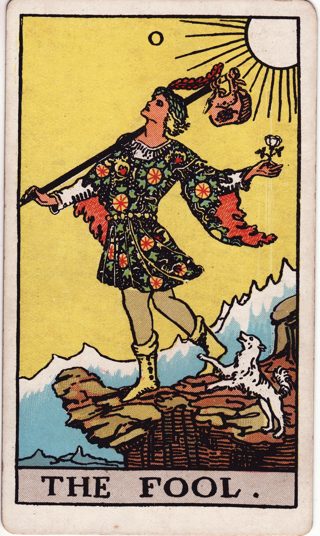
The Fool speaks to the moment before the leap, when the honest next step is simply to begin.
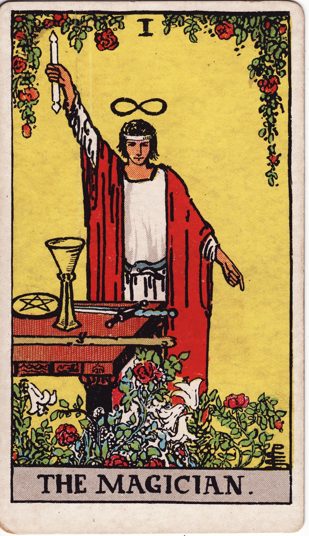
The Magician speaks to having more tools already in hand than you give yourself credit for.
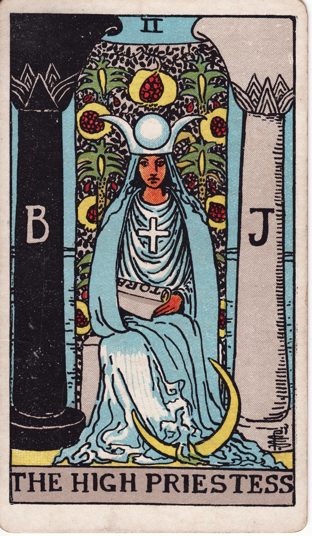
The High Priestess speaks to the knowing that arrives quietly, before there is proof to show anyone.
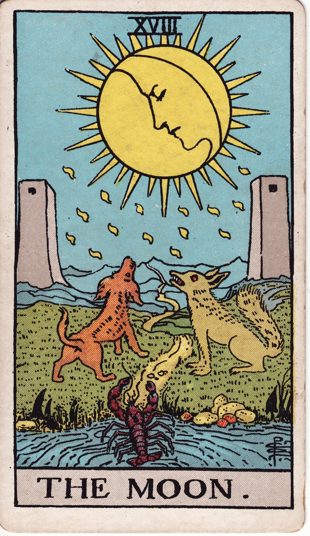
The Moon speaks to the stretch where things are not yet clear, and walking carefully matters more than walking fast.
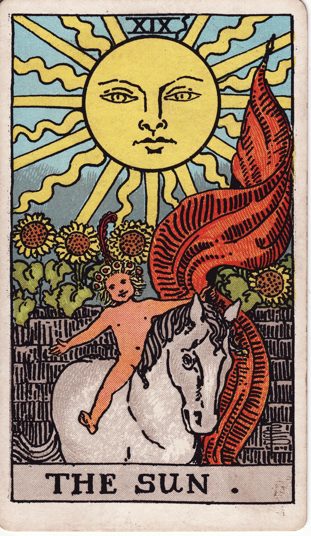
The Sun speaks to plain, uncomplicated joy, the kind that does not need to be earned first.
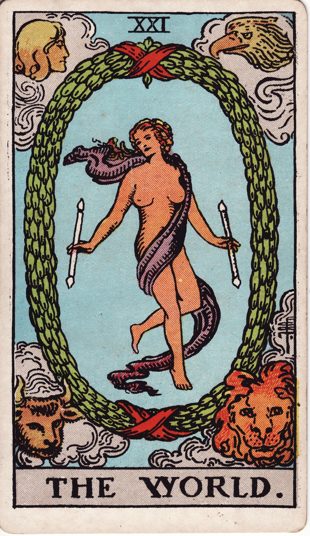
The World speaks to a long chapter closing well, with everything it taught you still yours to keep.
Lunalapin Tarot
The Story
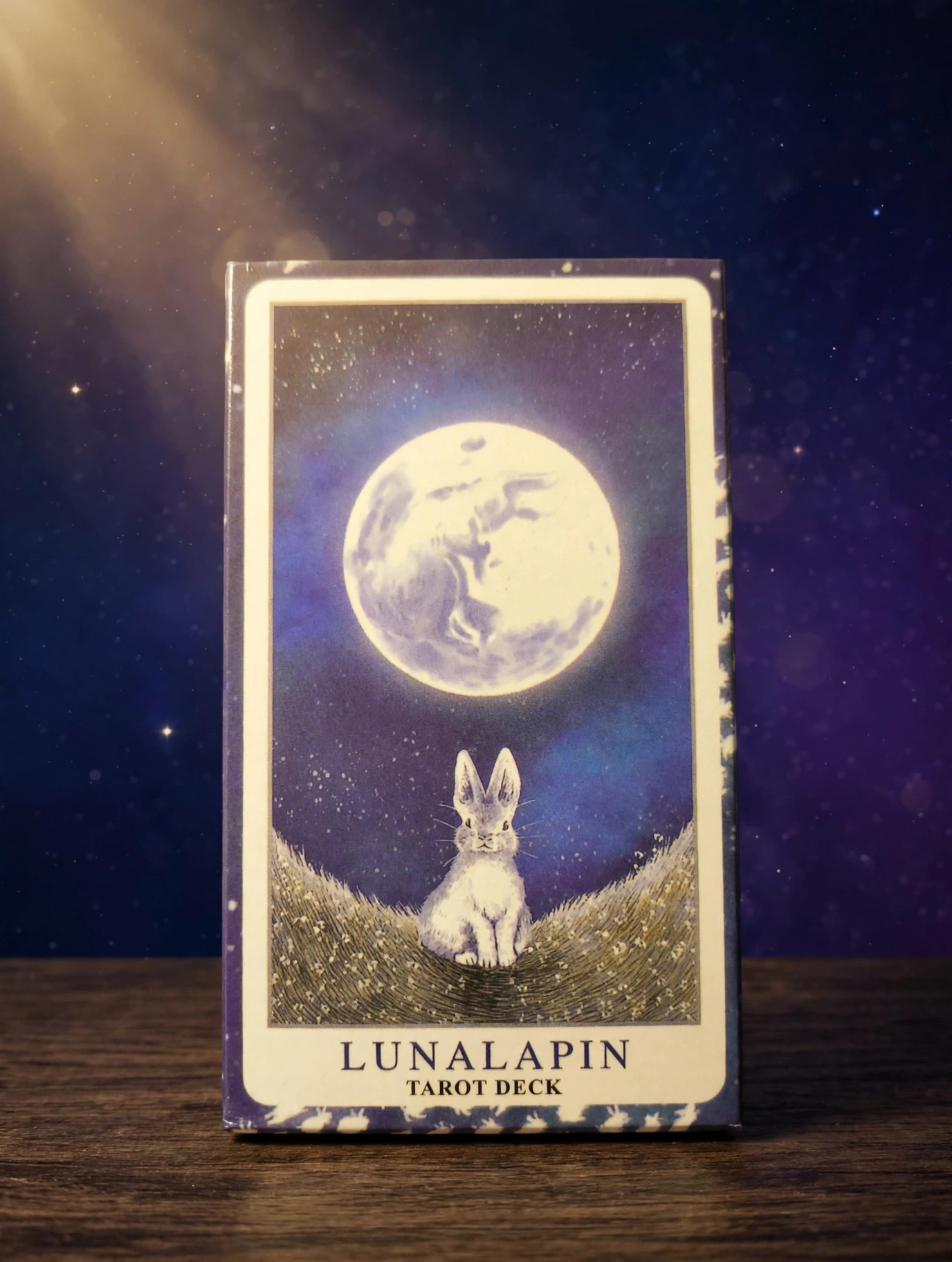
The Lunalapin Tarot was created by Thai artist Kanitsart Semanopparat and published by Mali Publishing in Thailand. It follows the structure of the Rider-Waite-Smith — the standard tarot, seventy-eight cards — and reimagines its scenes with rabbits, so the familiar pictures are all here, wearing softer faces.
Its Character
The box tells you its weather before a single card is drawn: a white rabbit sitting quiet on a dark hill, under a full moon big enough to light the whole night. The sky around it is the deep blue of the middle of the night, scattered with stars, and nothing in the picture is in a hurry.
That is the deck's weather: moonlit rabbits, deep blue nights, a gentle and tender tone throughout. But the softness is the surface, not the substance. This deck's personality is Strength — not brute force, but quiet control, patience over aggression, influence over confrontation — and what it keeps returning to, question after question, is imbalance, and where a life has tipped out of level.
From My Deck Interview
Under a full moon, I let the rabbits speak first: Strength stepped forward, followed by reciprocity, overload, avoidance, and the Devil waiting inside familiar habits. Their answers turned a soft-looking deck into a study of balance.
- What is your personality?
- Strength
- Where do your strengths lie?
- Six of Pentacles
- What are your limits?
- Two of Swords
- When should I call on you for guidance?
- Ten of Wands
- How will you challenge me?
- The Devil
- How will you inspire me?
- Queen of Cups
Read together, the six answers draw one pattern: control, imbalance, choice paralysis, overload, and self-imposed limitation. This is a deck oriented around the tendency to overextend, or to freeze at decision points, instead of using the steady influence it offers. Its strength is reciprocity — a clear-eyed exchange that shows where energy, resources, or attention are flowing unevenly — which makes it good for questions about fairness, generosity, or power dynamics in a relationship or at work.
Call on it when you are overloaded, carrying too much, close to burnout. It will challenge you by confronting the self-imposed restrictions — the habits, narratives, and dependencies we mistake for permanent chains — and it will inspire through emotional intelligence rather than logic. Its honest limit is avoidance: set in front of a decision someone is dodging, it mirrors the avoidance back rather than forcing clarity. What it wants, in the end, is to help you see where you are out of balance — whether that is giving too much, not taking enough responsibility, or refusing to choose.
The Harmony Tarot
The Story
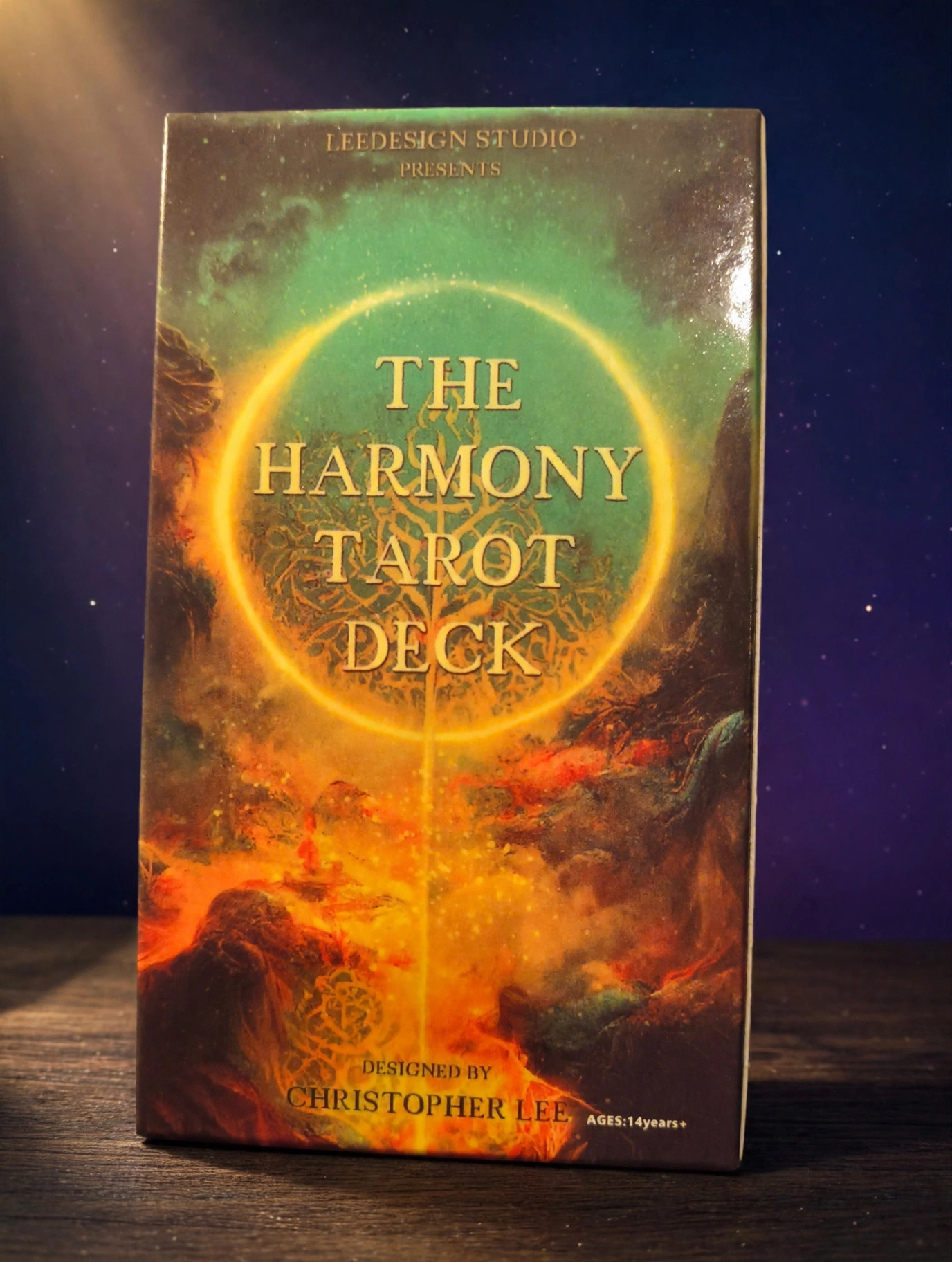
The Harmony Tarot Deck is presented by LeeDesign Studio and was designed by Christopher Lee (© 2022 LeeDesign Studio, LLC). It is a full deck of seventy-eight unique cards — the twenty-two Major Arcana and fifty-six Minor Arcana of the standard tarot.
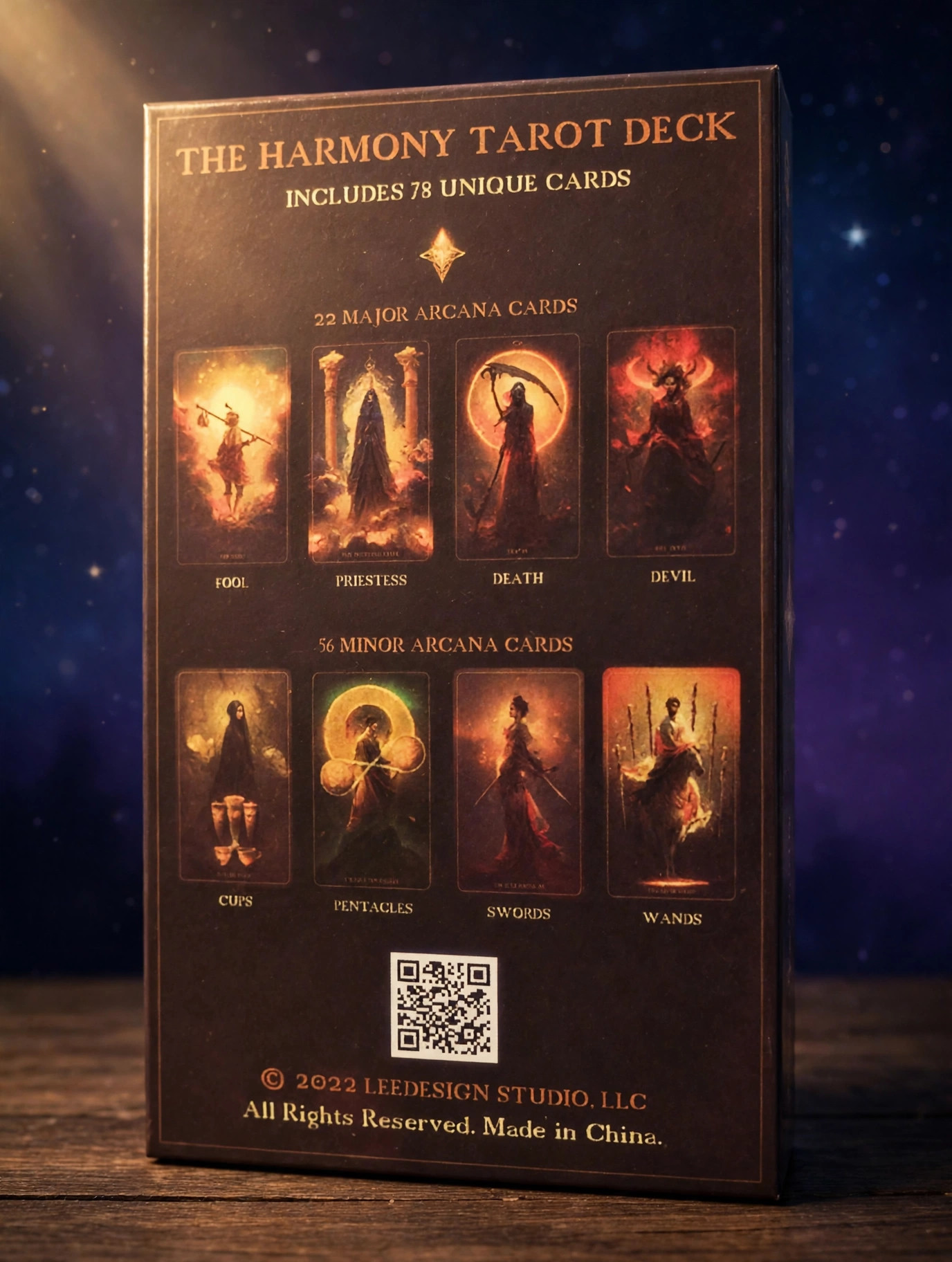
The box carries its emblem: a golden Tree of Life growing inside a ring of light, green glow above and fire below. Turn it over, and you get a first look at the artwork itself — the Fool, the Priestess, Death, and the Devil, with one card from each of the four suits — all of it painterly and ember-lit, figures rising out of the warm dark.
Its Character
This deck's personality is The Lovers. It is relational and choice based: it frames everything through connection and alignment, and it values union — bringing disparate parts into right relationship.
Its strength is The Fool — fresh starts, and leaps taken without overplanning. This is a deck built for beginnings. Its limit is just as plain: Justice. It will not hand you a comfortable answer when accountability is due.
Reach for this deck when your questions are relational, or about a new start you are hesitant on — and when a question turns on giving and receiving, generosity, fairness in exchange, or the power balance in a relationship or in money. Know, too, what kind of encouragement to expect from it: encouragement here comes from realism, not positivity.
From My Deck Interview
I opened this box looking at a golden tree, then asked where its warmth stops being comfort. The Lovers answered first; Justice set the boundary, while the Five of Pentacles pointed to what hardship had already taught me.
- What is your personality?
- The Lovers
- Where do your strengths lie?
- The Fool
- What are your limits?
- Justice
- When should we call on you?
- Six of Pentacles
- How will you challenge me?
- The Moon
- How will you inspire me?
- Five of Pentacles
Read together, the six answers describe a deck that reads through relationships first. It frames everything through connection and alignment — union, and bringing disparate parts into right relationship — and it is built for beginnings: fresh starts, and leaps without overplanning. When a question involves giving and receiving, generosity, fairness in exchange, or power balance in a relationship or in money, this is the deck that speaks its language.
It will not make things comfortable at the expense of the truth: it refuses comfortable answers when accountability is due. Its challenge is The Moon — expect it to surface what is unclear, hidden, or illusory, and to refuse a clean literal answer when the real issue is your own uncertainty, intuition, or fear of the unknown. And its inspiration is the Five of Pentacles: it shows what has been survived, highlighting the resilience found through lack rather than abundance — a reminder that struggle is not the end of the story. Reach for it when questions are relational, or about a new start you are hesitant on, and expect its encouragement to come from realism, not positivity.
The Wondering Spirit Tarot
The Story
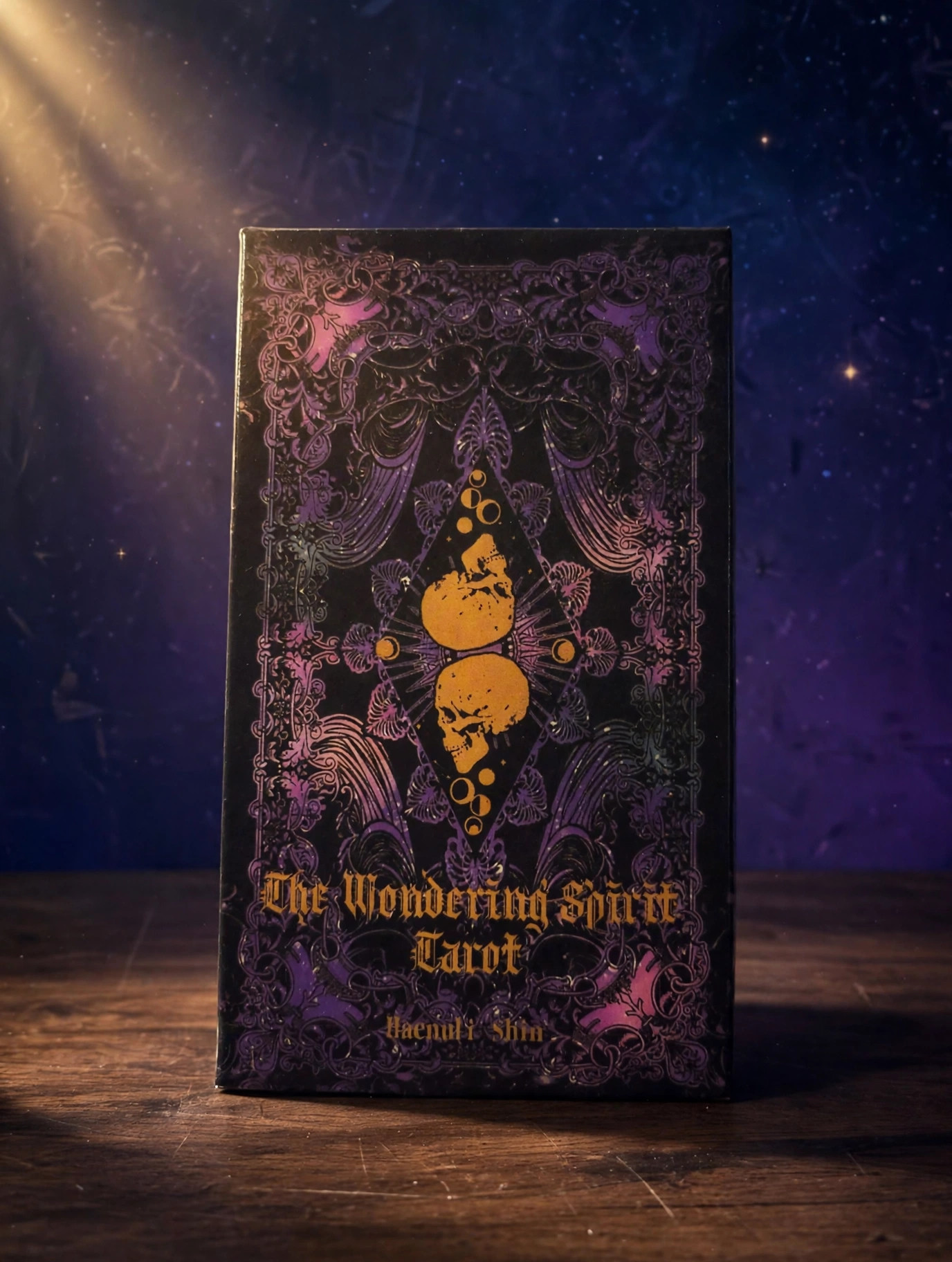
The Wondering Spirit Tarot is by artist Haenuli Shin, who is best known for her skeleton and girl series, which began with the book Their Story: Story You Don't Know. Here she takes those two characters — the skeleton and the girl, symbols in her work of depression and empathy — and adapts them to the form and meaning of tarot.
The box sets the tone before a single card is drawn: black and deep purple, dense with ornate filigree, and at the center two gold skulls turned toward the phases of the moon. Beautiful, and not in the least bit soft.
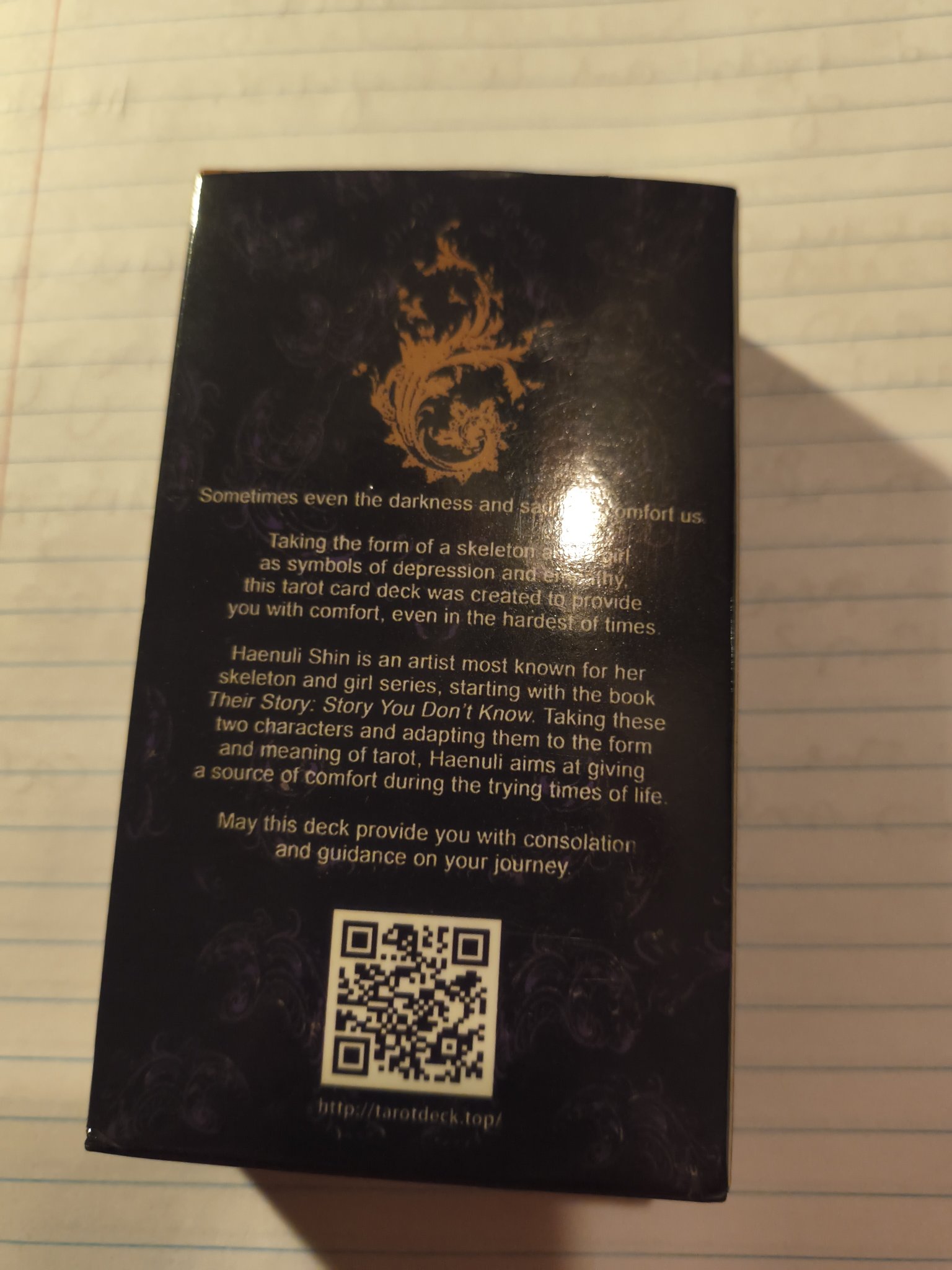
The artist's stated aim, in the box's own words, was comfort: the deck "was created to provide you with comfort, even in the hardest of times," and its closing wish is that it "provide you with consolation and guidance on your journey." Remember that she said so — because how this deck actually behaves on my table is the most interesting thing about it, and it is told straight below.
Its Character
Its personality is visionary: forward looking, adventurous, expectant. I call it a lookout guide — it does not focus on the past, but looks toward the horizon to help plan the next big expansion.
Its strength is brutal honesty — finality, an end to denial, rock bottom truth. It shines when absolute clarity is needed, and it helps you accept when something is finally over, so moving on is possible. Its limitations are the same edge turned around: it is heartbreaking, blunt, emotionally piercing, and it lacks softness. My own interview note is the bluntest line on this page, and nothing here will soften it: "Don't come to this deck for gentle comfort."
From My Deck Interview
No cards came up when I questioned this one. Shin’s skeleton and girl answered through temperament instead: lookout, blunt witness, poor comforter, and a guide who keeps facing the horizon.
- What is your personality?
- Visionary, forward looking, adventurous, expectant
- What are your strengths?
- Brutal honesty, finality, ending denial, rock bottom truth
- What are your limitations?
- Heartbreaking, blunt, lacks softness, emotionally piercing
- When should I call on you?
- Stalemates, tough choices, mental blocks, indecision — stuck between two choices
- How will you inspire me?
- Rebirth, transformation, radical change, clearing clutter
- How will you challenge me?
- Challenges moodiness, exposes illusions, tests romanticism
Read together, the six answers describe a lookout. This deck faces forward — toward the horizon, toward the next big expansion — and it comes into its own in a stalemate, when a tough choice will not resolve and something has to give. It will challenge moodiness, expose illusions, and test romanticism, and what it offers in return is not softness but movement: rebirth, transformation, radical change, the clearing of clutter.
And here is the tension, stated plainly because this page does not smooth things over: the artist made this deck to comfort people in the hardest of times, and in my hands it is the deck of hard truths. Both are true. I don’t ask it for gentle comfort — I ask it to say when something is over, and to mean it.
Cosmic Garden Tarot
The Story
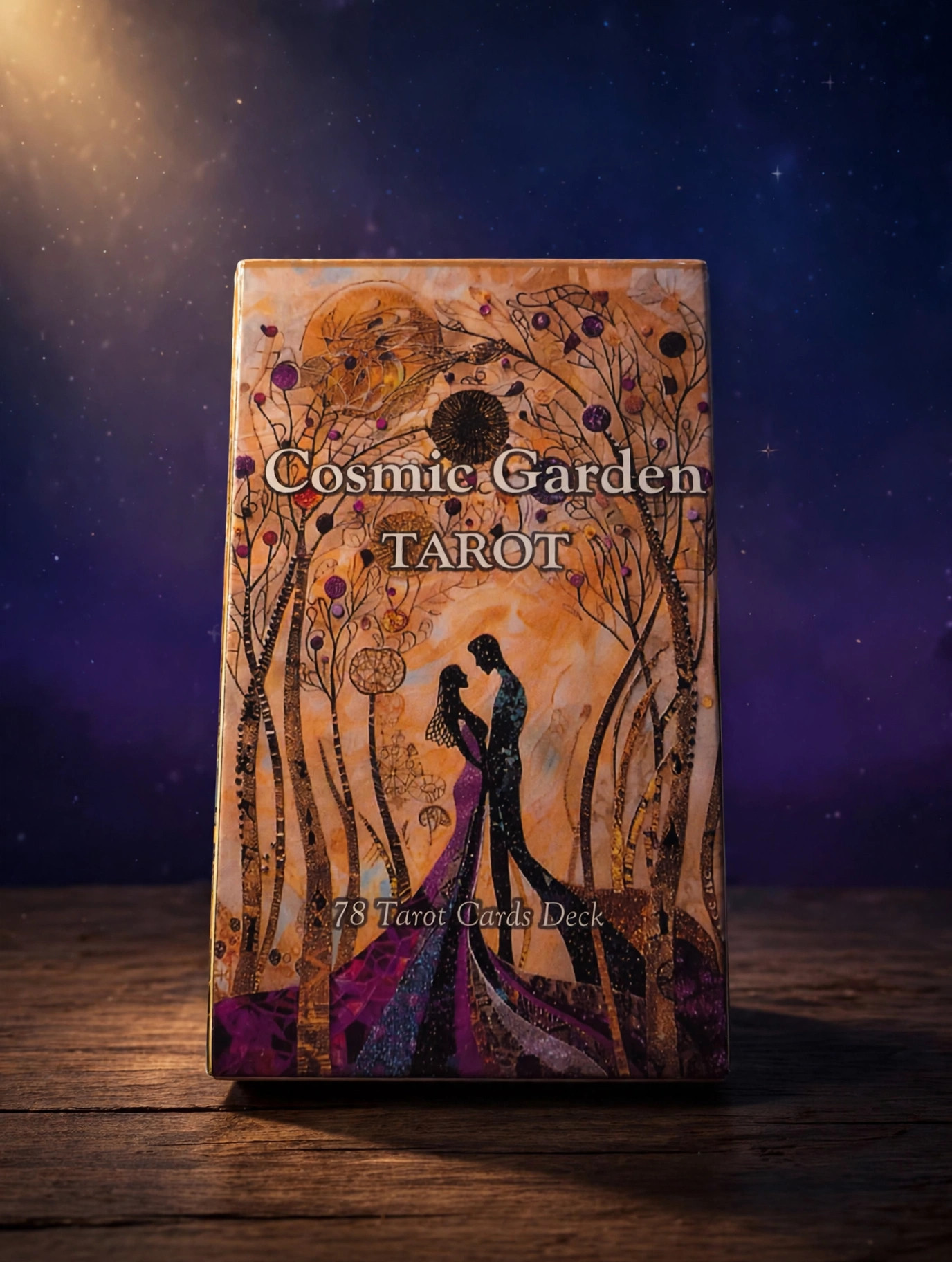
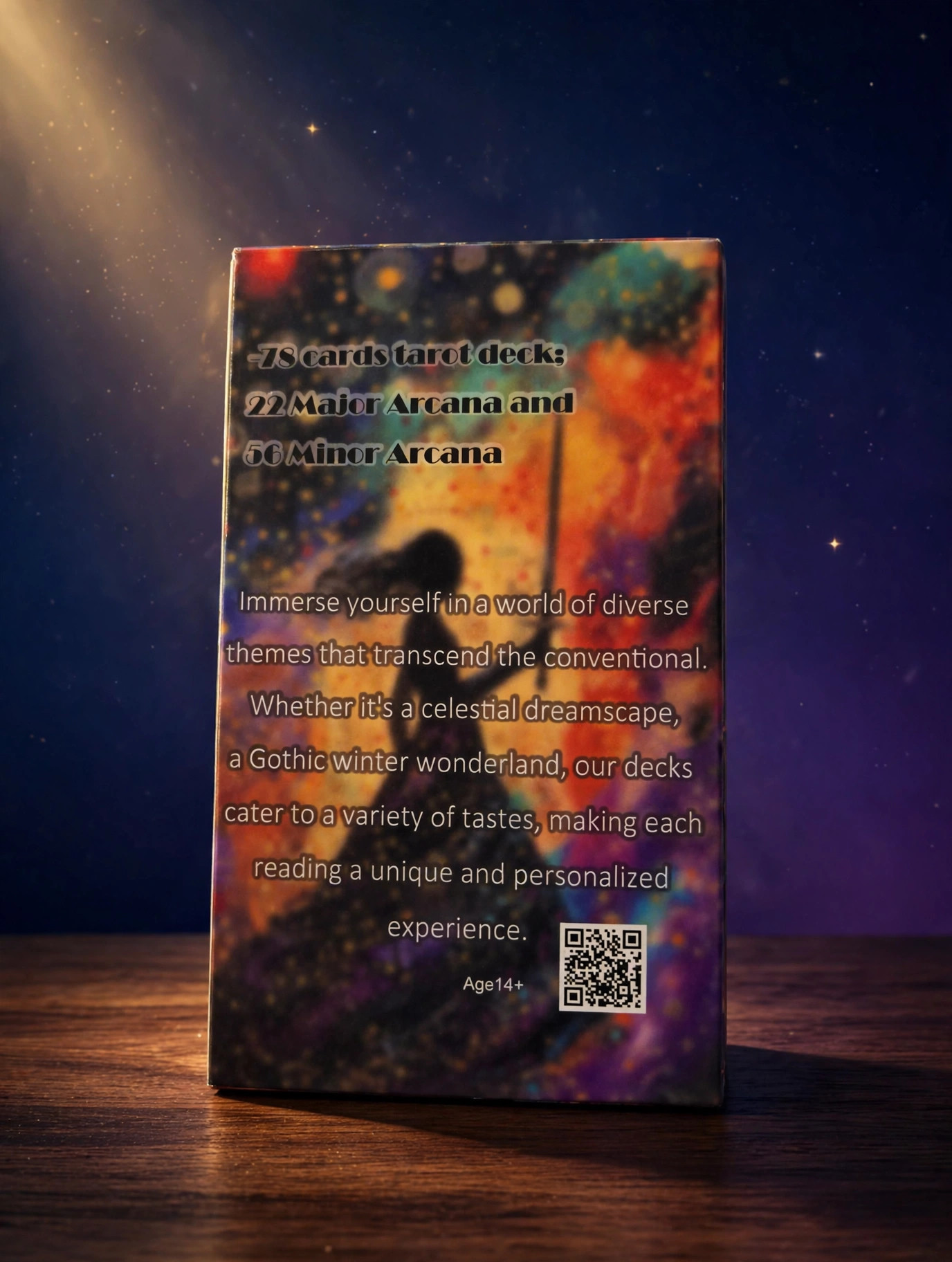
The Cosmic Garden Tarot is a full deck of seventy-eight cards — the twenty-two Major Arcana and fifty-six Minor Arcana of the standard tarot. Beyond that, its box keeps its mysteries: it names no creator and no publisher, so none is claimed here. What the box promises, in its own series pitch, is a world of diverse themes that transcend the conventional, and a reading that is a unique and personalized experience.
The artwork speaks for itself: on the box, a couple stands close in silhouette among tall, slender trees, in gold and amber and deep purple — decorative and dreamlike, with something of Klimt's golden forests about it. Turn the box over and the same palette deepens into a starfield.
Its Character
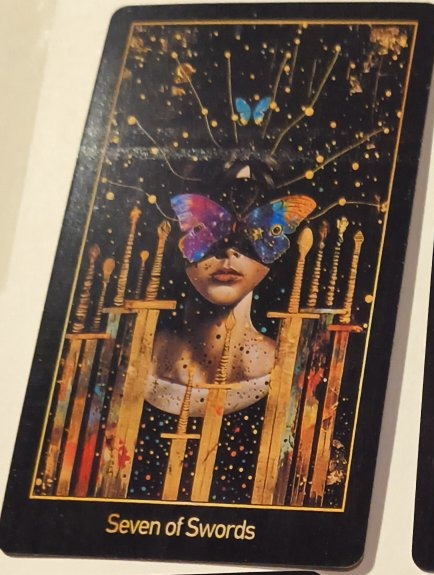
Its personality is the Seven of Swords: sharp, strategic, and deeply psychological. This deck works in what is hidden — motives, tactics, and the thing not being said — and it reads a situation by what is being concealed as much as by what is shown.
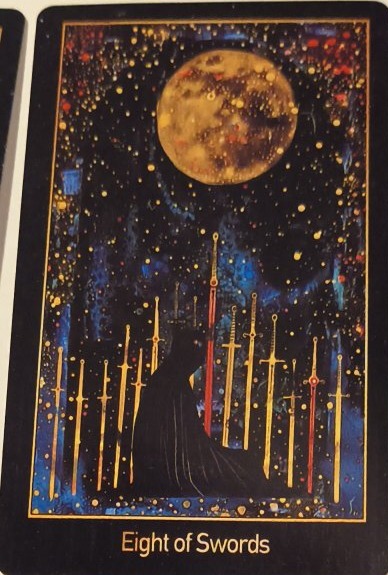
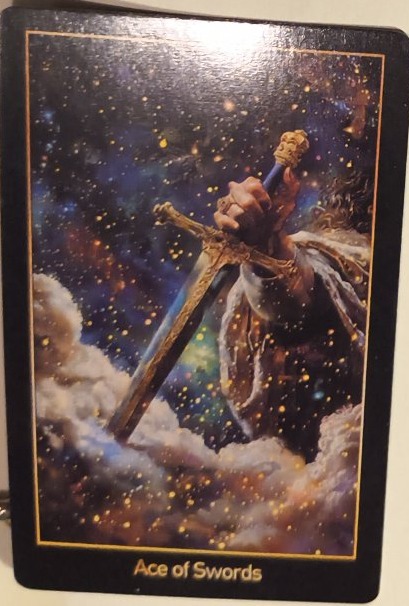
Its strength is the Eight of Swords: mental traps and self imposed limits. It dissects the feeling of being stuck, blindfolded by your own perspective, and shows where the restriction is being maintained from the inside. Its limit is the Ace of Swords reversed, and it is an honest one: it can point at the truth, but it will not force the breakthrough, and it will not clear the fog for you before you are ready.
From My Deck Interview
Gold leaves can hide a sharp mind, so I watched what this garden refused to reveal. Seven of Swords took the lead, Eight of Swords mapped the trap, and a reversed Ace marked the limit of its honesty.
- What is your personality?
- Seven of Swords
- Where do your strengths lie?
- Eight of Swords
- What are your limits?
- Ace of Swords (reversed)
- When should I call on you?
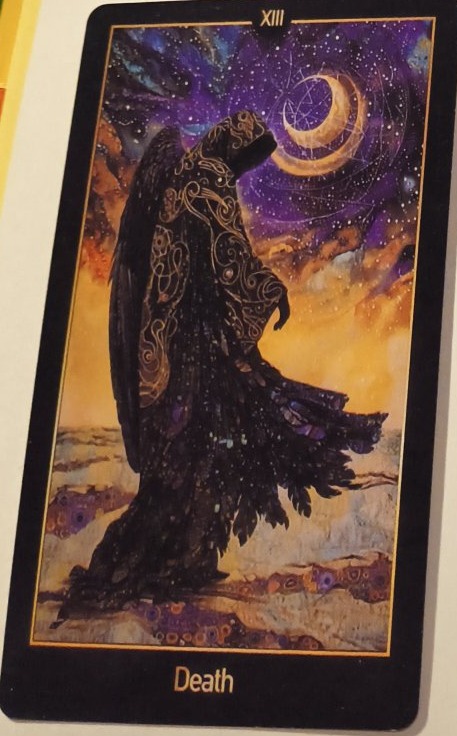
- Death
- How will you challenge me?
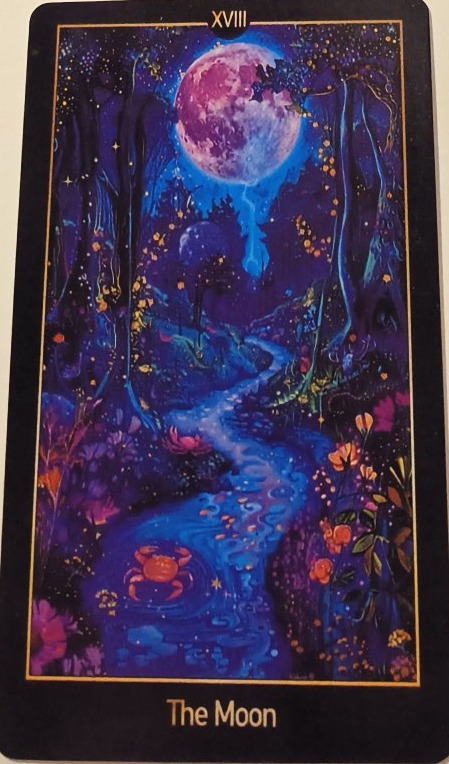
- The Moon
- How will you inspire me?
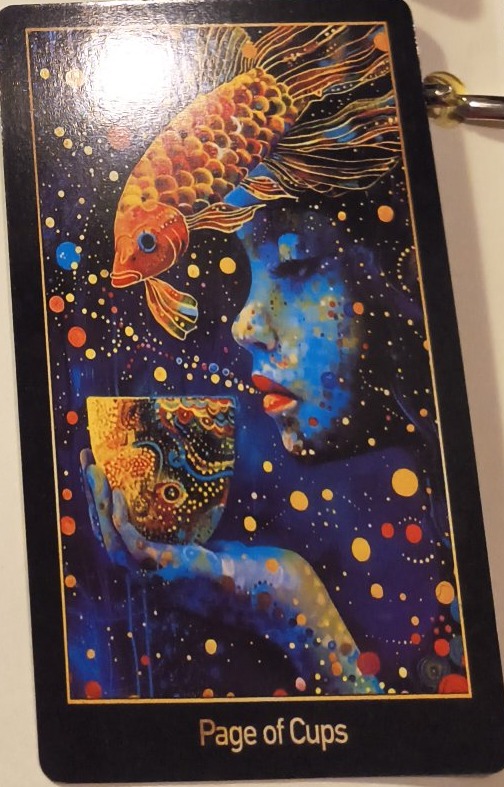
- Page of Cups
Read together, the six answers describe a deck that listens for what is underneath. Call on it in transitions and endings, when an old skin is ready to be shed and something is asking to be let go. It will challenge you the way The Moon does: into illusions, anxieties, and the fears underneath the story you tell yourself, with no skating on surface assumptions. And what it offers back is the Page of Cups — imaginative wonder, emotional curiosity, the open heart of a student again.
This is the deck for hidden motives, mental traps, and transitions — serene art, unsentimental mind.
The Six Cards of Its Interview
These are photographs of my own deck — the six cards of its interview, in the order they were drawn.
A Totally Unofficial Adventure Time Tarot
The Story
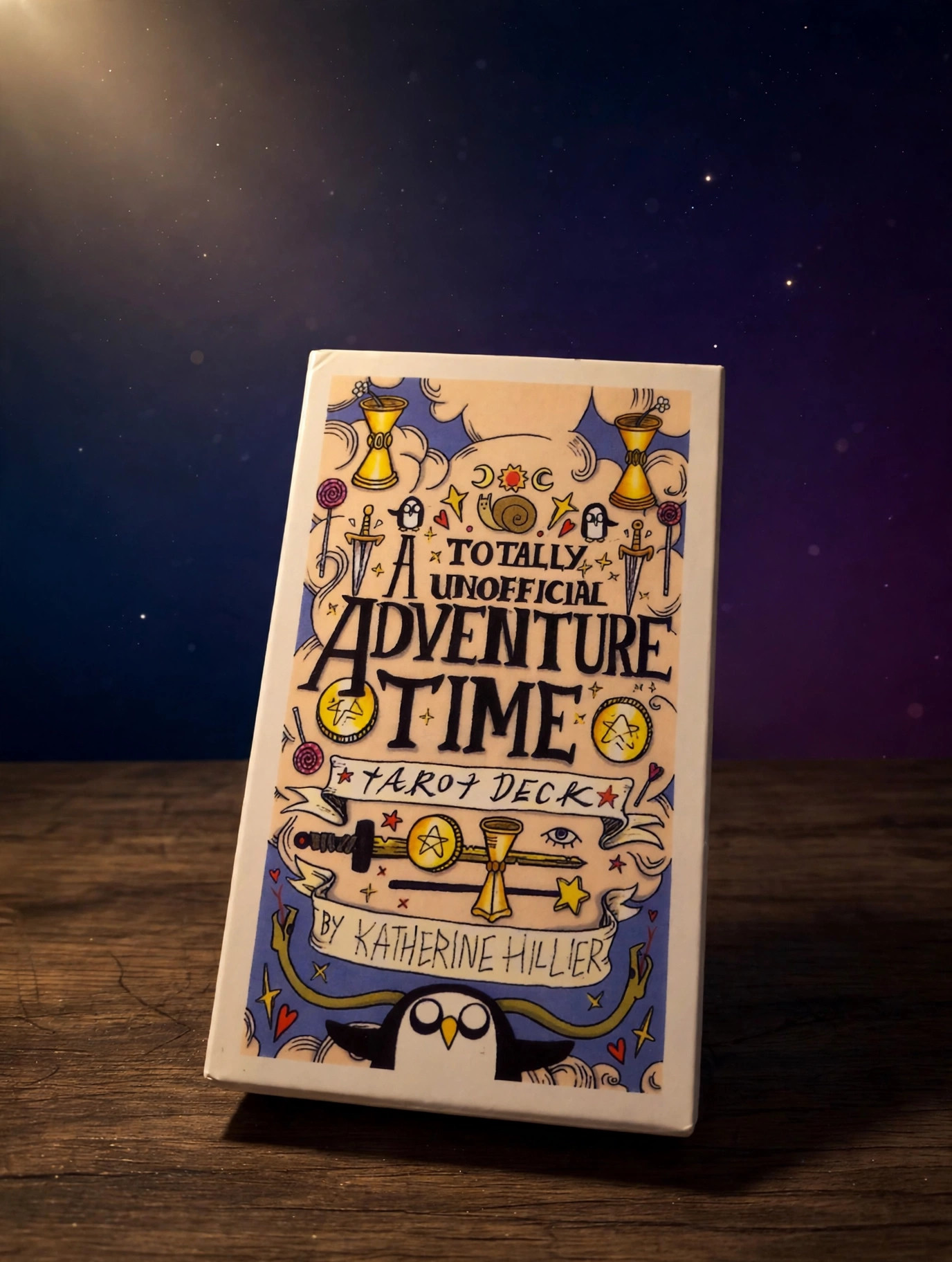
Every shelf is allowed one deck that is pure fun, and this is mine. It is exactly what it says on the box: A Totally Unofficial Adventure Time Tarot Deck, devised and illustrated by Katherine Hillier. It is a fan-made tribute to the Adventure Time cartoon — drawn with obvious love, and with no affiliation with Cartoon Network, which did not license or endorse it. The box says so itself, right in the title, and this page is glad to say it just as plainly.
Underneath the silliness it is a serious piece of construction: a complete deck of seventy-eight cards, inspired by the iconic Rider Waite designs, so the familiar pictures are all here. The art is hand-drawn doodle work in cream and blue — Gunter the penguin, the little snail who hides somewhere in every episode, lollipops, chalices, swords and pentacles, all scattered across the box like a notebook page that got happily out of hand.
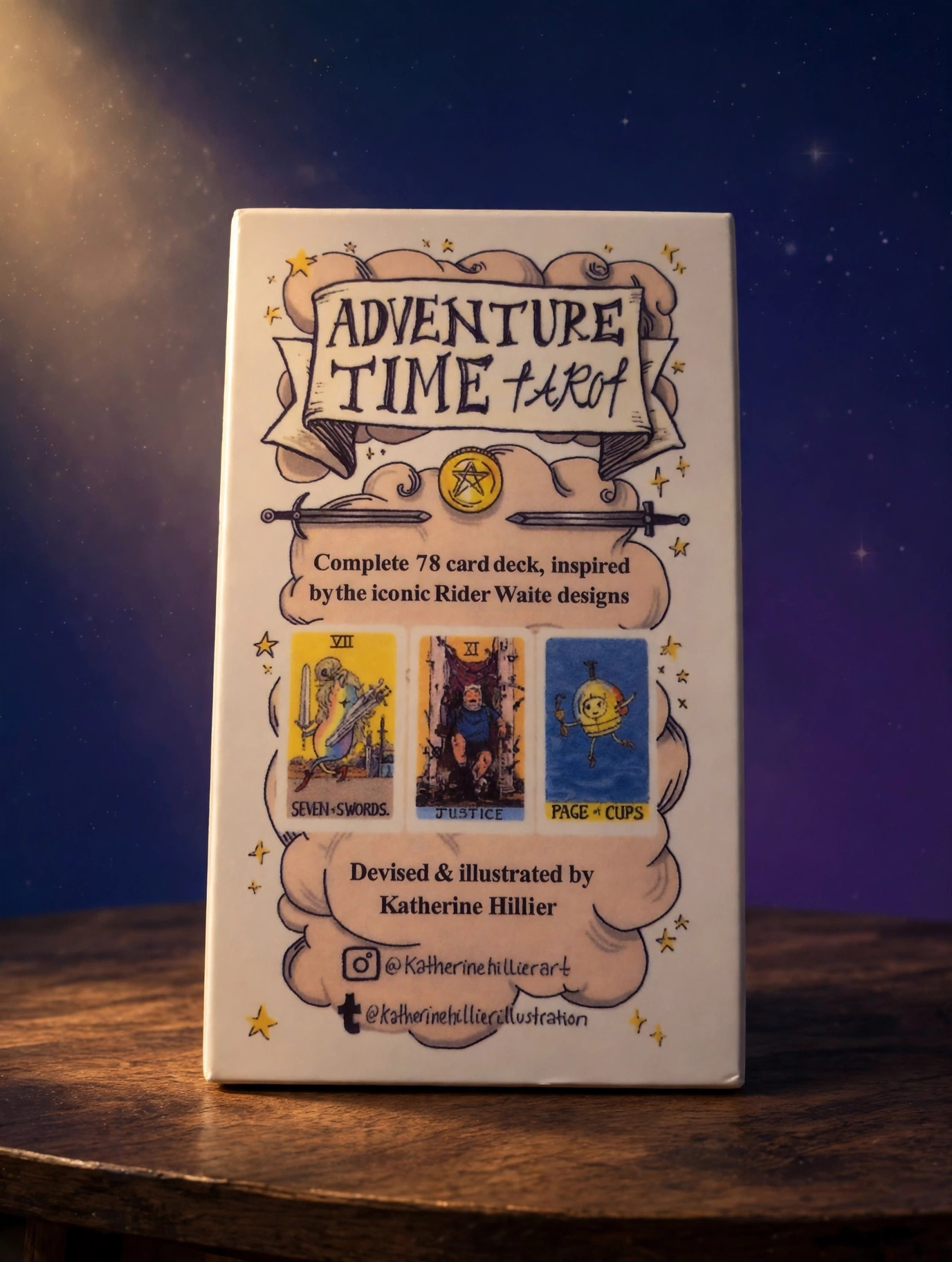
Turn the box over and you can see three of the cards themselves — the Seven of Swords, Justice, and the Page of Cups — and find the artist: Katherine Hillier is on Instagram at @Katherinehillierart and on Tumblr at @katherinehillierillustration.
Still Getting Acquainted
This is a new deck on my table, and — like the Cosmic Garden just above — it has not sat for its interview yet. Every deck I work with gets six questions and six honest answers before I claim to know it, and I will not invent a personality for this one in the meantime, however much personality it is already waving around. When I do interview it, its answers will be added here, the same as the others.
The Black and Gold Deck
The Story
This is the deck I learned on — my very first deck, the beginners deck I started with before there was a shop, a page, or a single client. It follows the standard tarot: seventy-eight cards, the same structure this shop teaches in. It is still on the table, and it still works.
There is no photograph of it on this page, and there will not be one until there is a real one to show. This page would rather introduce a deck in honest words than show you a picture that is not really it — so its introduction rests on the evidence that matters most anyway: how it reads, in my own interview with it.
Its Character
Its personality is the Knight of Swords: highly intellectual, fast paced, and brutally honest. It does not sugarcoat. It cuts straight through confusion and delivers information rapidly and sharply, and a reading with it moves at that speed — think first, in logic, and expect the plain answer quickly.
Its strength is the Emperor reversed, which tells you something about its temperament: non-conformist, flexible, and anti-authoritarian, with its strengths in breaking traditional rules — dismantling rigid structures and thinking outside the box rather than defending how things have always been done.
Four of its six interview answers are reversals, and that is the deck in miniature: it speaks in what is blocked, stalled, or upside down. Its territory is the stuck loop — the cycle of bad luck that will not break, the habit that outlived its use, the reality being avoided, the fear being mistaken for intuition. Where the Wondering Spirit speaks of endings and finality, this deck speaks of cycles: things that keep turning because something in us keeps turning them.
From My Deck Interview
Before this shop had a name, my worn beginner’s deck was teaching me how I think. I returned to it years later and found reversals crowding the table, each one circling a refusal to release what was finished.
- What is your personality?
- Knight of Swords
- Where do your strengths lie?
- The Emperor (reversed)
- What are your limits?
- Holding on, staying put and refusing to walk away
- When should I call on you?
- Wheel of Fortune (reversed)
- How will you challenge me?
- The Moon (reversed)
- How will you inspire me?
- Page of Wands (reversed)
Read the limits answer carefully, because it is the honest heart of this deck: it notices the struggle to let go of things that no longer serve — the lingering in stagnant situations, the cycling back to old habits instead of moving forward — and it will not help anyone pretend otherwise. Call on it in bad luck and stagnant periods, when life feels completely stalled and you are feeling stuck in a rut, like a victim of bad timing. It will challenge by exposing secrets, facing reality, and releasing fear. And what it offers in return is focus: grounding chaotic energy, finding focus, turning scattered ideas toward one solid plan.
Know what you are picking up. This is not the deck for a gentle answer, and I don’t reach for it when gentle comfort is what a reading needs. It is the deck for the moment someone is ready to hear the fastest, most logical way out of the loop — said straight, and said once.
Questions This Deck Loves
I keep a list, in my own notebook, of the questions this deck answers best. They are mine, word for word:
- What is keeping me stuck in this loop?
- How can I break this cycle of bad luck?
- What old habit am I refusing to let go of?
- What reality am I currently avoiding?
- What fears am I mistaking for intuition?
- Where am I actually deceiving myself?
The Oracle Shelf
The decks below are not tarot, and this page will not pretend otherwise. They are different instruments that work beside the tarot on my table: oracle decks drawn as a single closing note after the tarot has spoken, and mirror cards held up for a quieter kind of reflection. Each one is introduced only by what is known of it so far — its box, its makers where its box names them, and its own words — and each will get its full introduction the same way the tarot decks did: after I have sat down with it and asked.
The Starseed Oracle
The Story
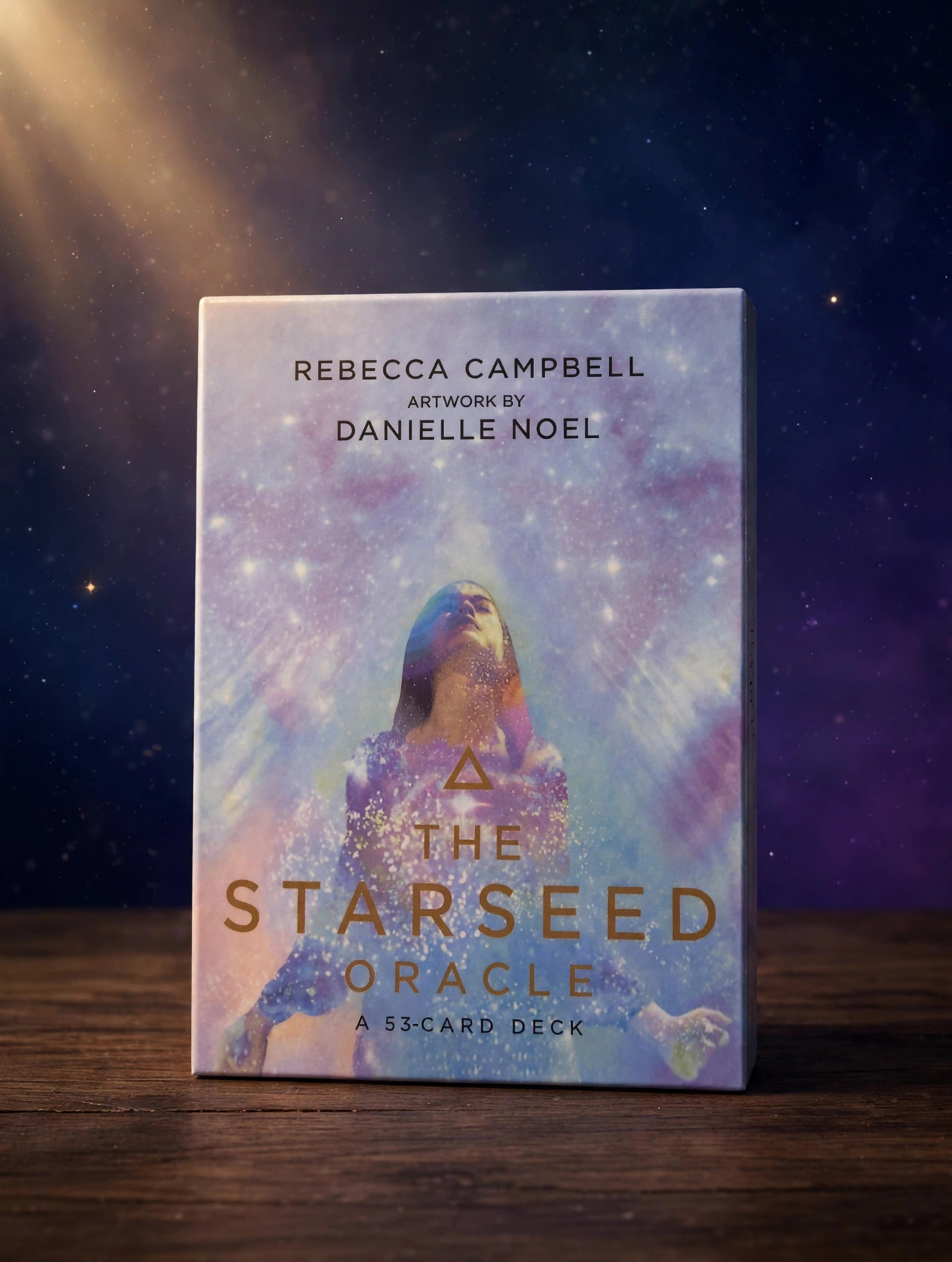
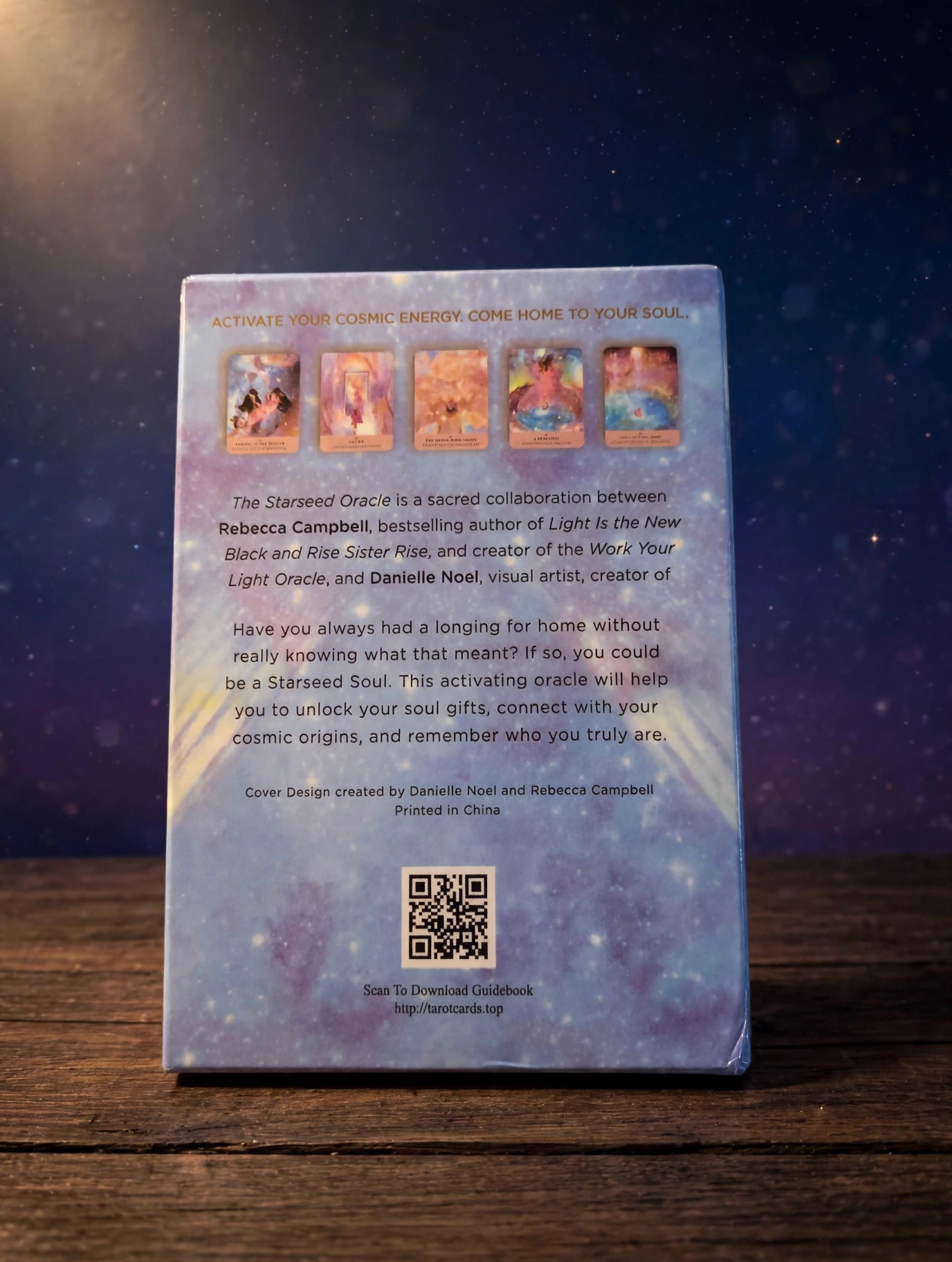
The Starseed Oracle is an oracle deck of fifty-three cards, by Rebecca Campbell with artwork by Danielle Noel. Campbell is the bestselling author of Light Is the New Black and Rise Sister Rise, and the creator of the Work Your Light Oracle; Noel is the visual artist whose work covers these cards. The box calls the deck their sacred collaboration. Its guidebook is reached by a code printed on the box rather than bound into it — and the box names no publisher, so none is claimed here.
Its subject is the Starseed idea, in the box's own words: "Have you always had a longing for home without really knowing what that meant? If so, you could be a Starseed Soul." The deck promises to help its reader "unlock your soul gifts, connect with your cosmic origins, and remember who you truly are," under its own banner line: "Activate your cosmic energy. Come home to your soul."
The art is the first thing the box shows you: a woman's face turned upward, eyes closed, her whole figure loosening into a nebula — lavender, rose, and pale blue, thick with stars. Nothing about it is sharp or structured; it is all drift and glow.
Still Getting Acquainted
This deck has not sat for its interview yet, so this is all that will be said of it here: its box, its makers, and its own words. I have not sat down with it yet, and I will not invent a personality for it in the meantime. When I do interview it, its answers will be added here, the same as the decks above.
Barbieri Zodiac Oracle
The Story
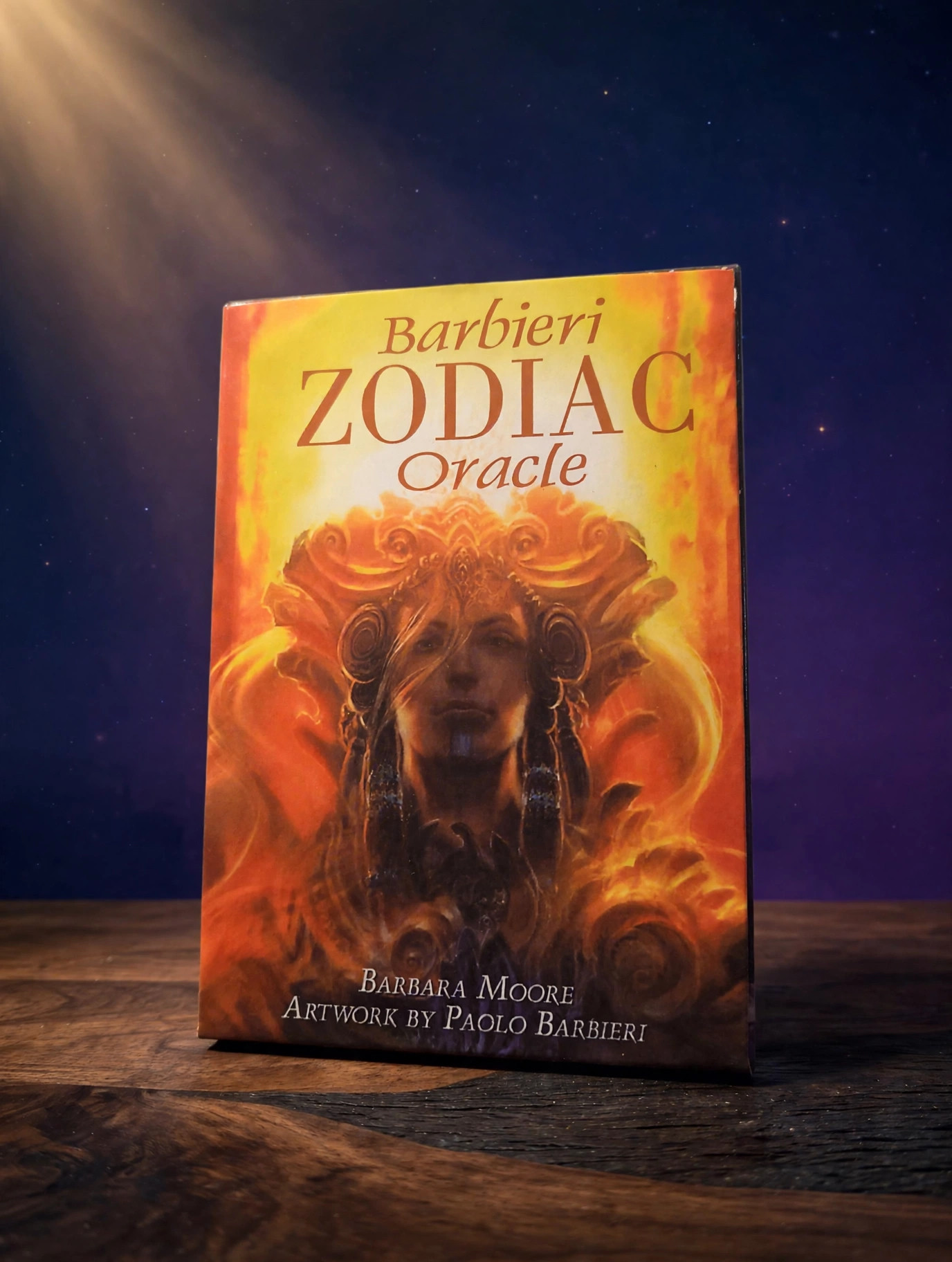
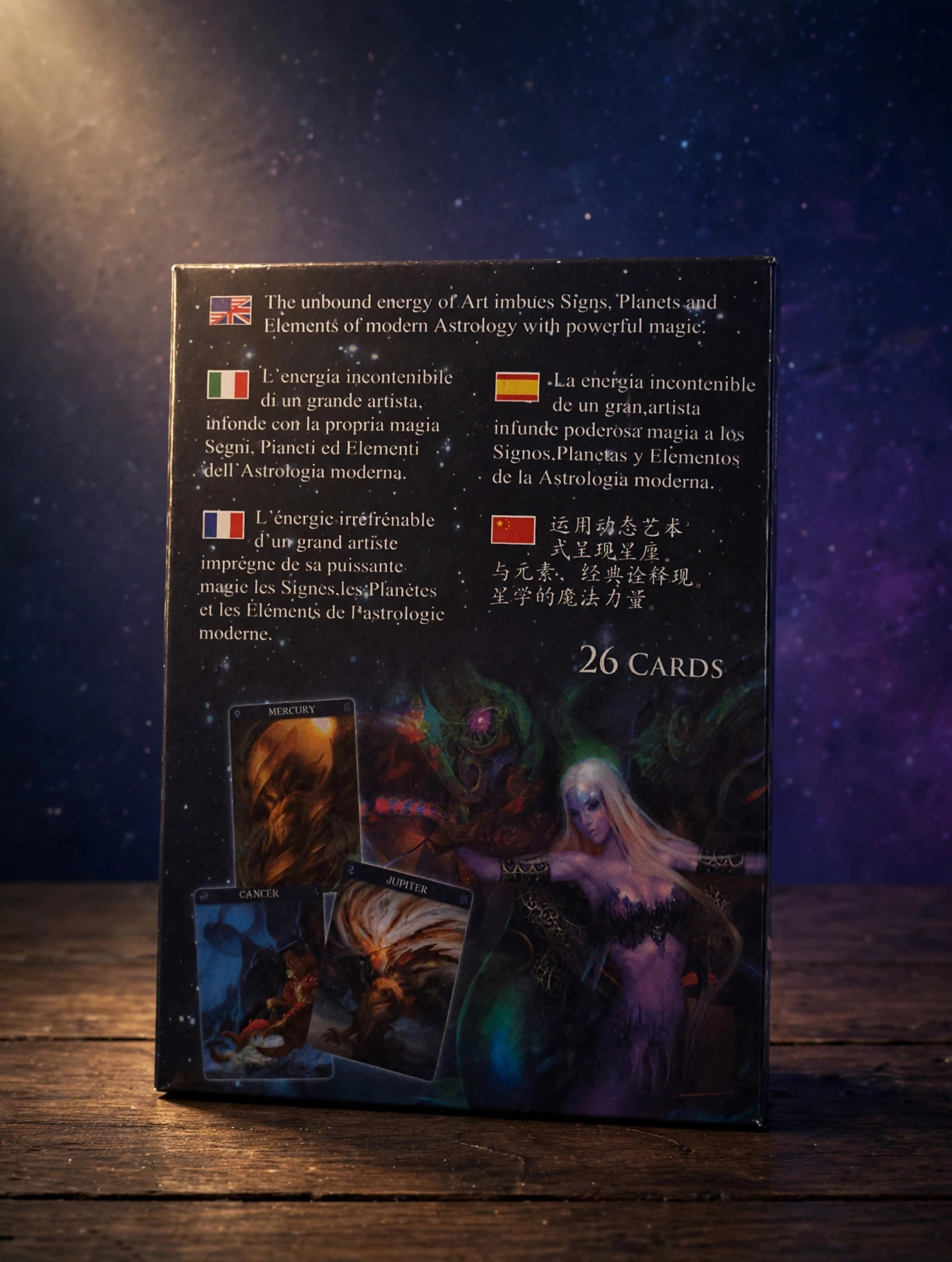
The Barbieri Zodiac Oracle is an oracle deck of twenty-six cards, with text by Barbara Moore and artwork by Paolo Barbieri. Its whole subject is astrology: in the box's own English words, "The unbound energy of Art imbues Signs, Planets and Elements of modern Astrology with powerful magic" — a promise the box repeats in Italian, Spanish, French, and Chinese.
Turn the box over and three of the cards show themselves against a starfield: Mercury, Cancer, and Jupiter — a planet, a sign, and a planet, exactly the deck's stated ingredients. Barbieri's art is painted and dramatic: the cover is a woman's face rising out of flame-orange swirls, crowned with an ornate sunburst headdress, all fire and gold.
Of all the decks on this page, this is the one that speaks the shop's other language outright. Astrology is half of what happens here, and a zodiac oracle belongs beside the birth charts and forecasts as naturally as the tarot belongs beside the readings.
Still Getting Acquainted
This deck has not sat for its interview yet. I have not sat down with it yet, so Barbara Moore’s words, Paolo Barbieri’s artwork, and the three cards visible on the box will carry its introduction for now. When I do interview it, I’ll add what I learn here rather than guessing beforehand.
She Is
The Story
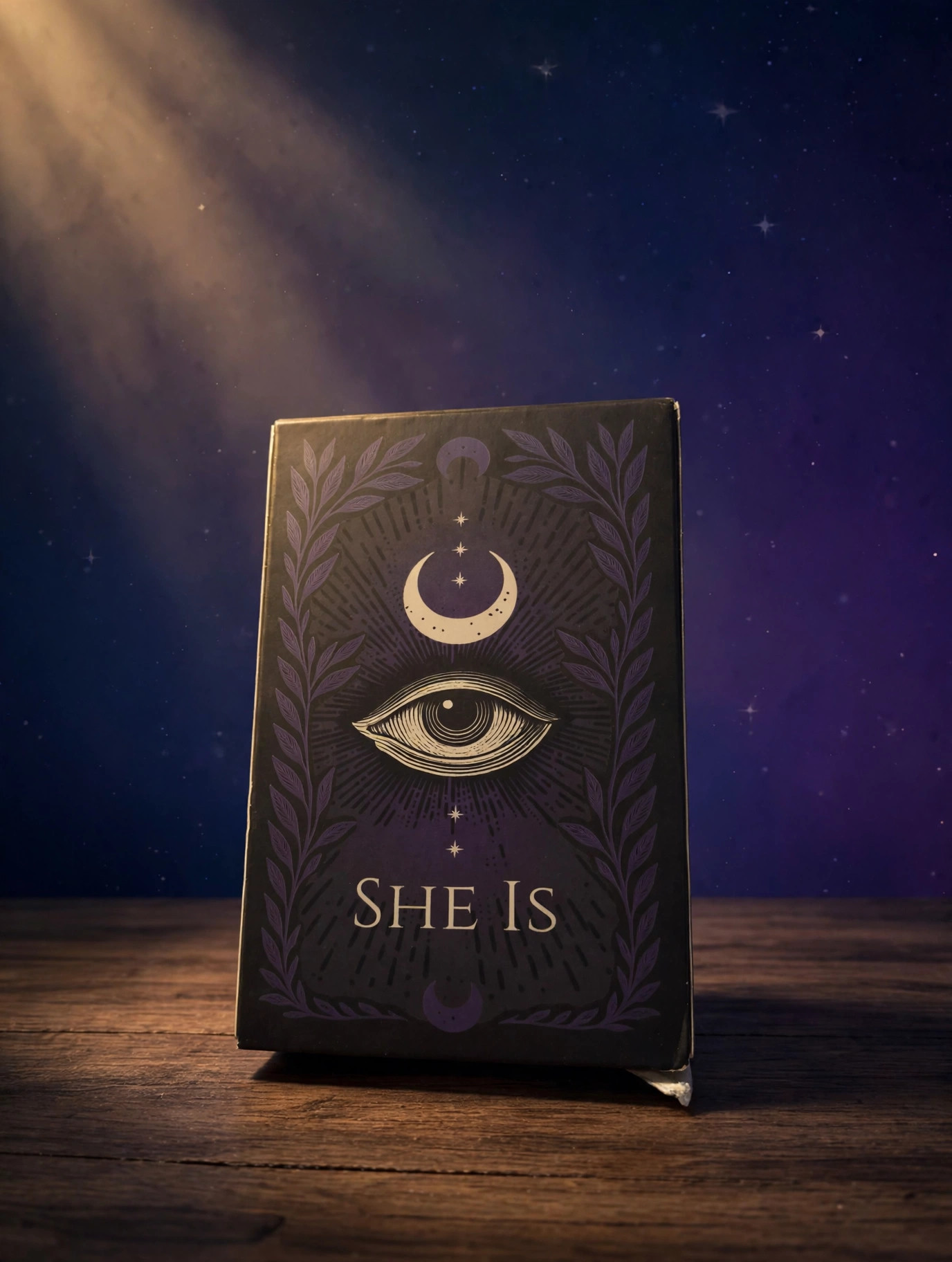
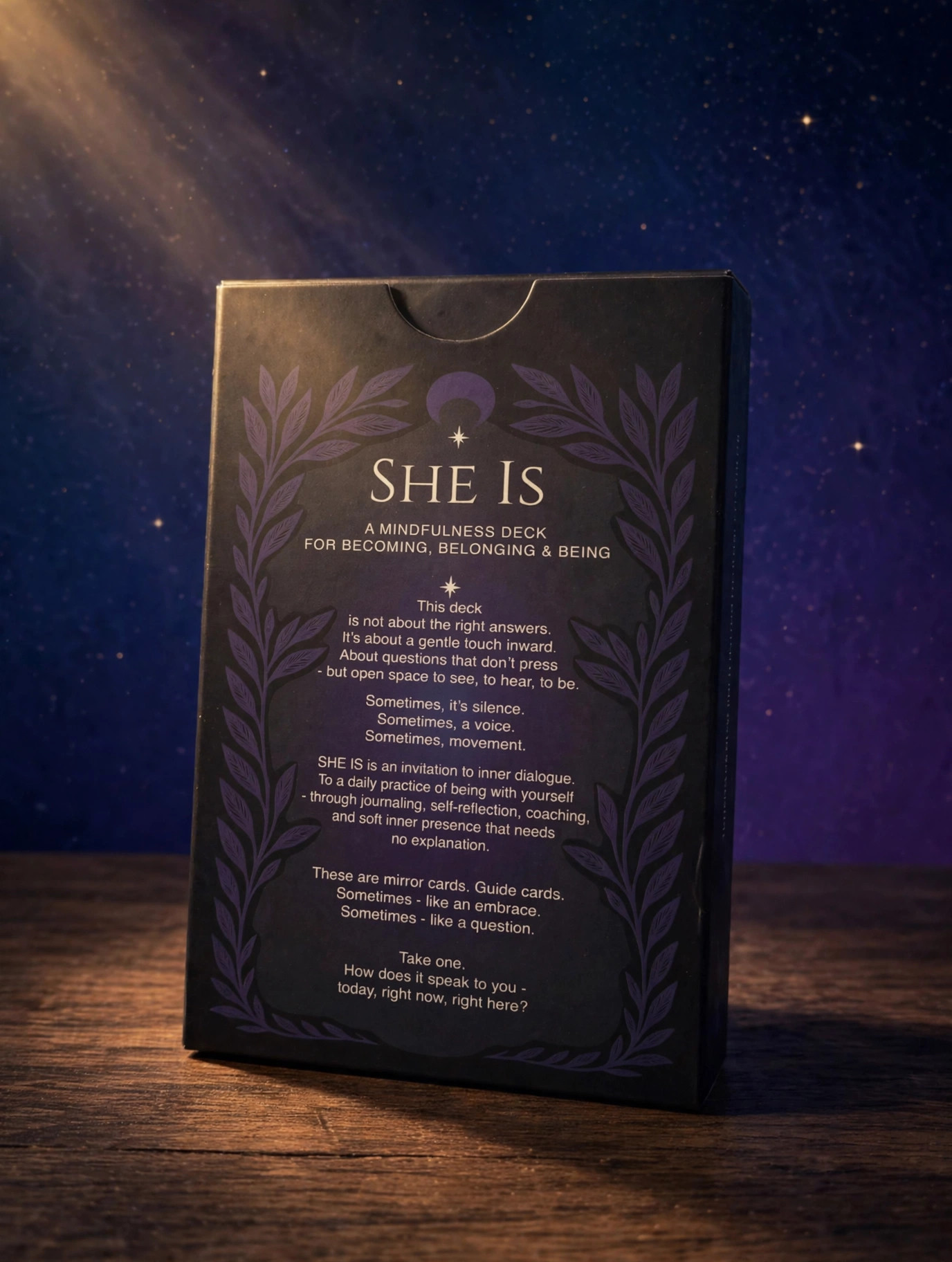
She Is calls itself, on its own box, "a mindfulness deck for becoming, belonging & being" — and that is exactly what it will be called here. It is shelved with the oracle decks because it works the way they work, one card held up at a time, but it does not claim to tell fortunes and this page will not claim it for one. Its box names no creator, no artist, and no publisher, and does not say how many cards it holds — so none of that is claimed here.
What the box does offer is the deck's own manifesto, and it is worth more than any description: "This deck is not about the right answers. It's about a gentle touch inward. About questions that don't press — but open space to see, to hear, to be." It calls its cards "mirror cards. Guide cards. Sometimes — like an embrace. Sometimes — like a question," and it is made, it says, for journaling, self-reflection, and "soft inner presence that needs no explanation." Its whole instruction is a single line: "Take one. How does it speak to you — today, right now, right here?"
The box itself is the quietest object on this page: near-black indigo, a crescent moon and three small stars above a single wide-open eye, the whole design framed by two laurel branches. It looks the way it says it works — still, dark, and watching.
Still Getting Acquainted
This deck has not sat for its interview yet, so this is all that will be said of it here: its box and its own words. I have not sat down with it yet, and I will not invent a personality for it in the meantime. When I do interview it, its answers will be added here, the same as the decks above.
The Same Cards, Wherever You Look
These are the decks on my table. The Rider-Waite-Smith is the one you will see in most readings here, in the spread photo that comes with your reading, and throughout Ava's Study, where the Card of the Day teachings are drawn from these same seventy-eight pictures. The Lunalapin works beside it — gentle in tone, and direct about where things fall out of balance. The Harmony Tarot works there too, reading through connection first and built for beginnings. The Wondering Spirit Tarot works there too — forward looking, blunt, and honest about endings. The Cosmic Garden Tarot is on the table too — present, beautiful, and still being gotten to know. The Adventure Time Tarot is on the table as well — unofficial, fan-made, cheerful to the point of silliness, and still being gotten to know. And the Black and Gold Deck — my very first deck, the beginners deck I learned on — works there too: fast, sharp, and built for the stuck loop. Below them sits the Oracle Shelf, where three different instruments work beside the tarot: The Starseed Oracle, the Barbieri Zodiac Oracle, and She Is — drawn as a closing note or held up as a mirror, never as tarot. And if my collection grows, each new deck will get its own introduction the same way.